Monday, February 10, 2020

Day 14/36: Sunday, February 9, 2020: Ushuaia

We spent the night at dock in Ushuaia. This morning, I got up and went to the gym before breakfast. We have a 9:00 am excursion to visit the old prison and then take a ride on the Tierra del Fuego Southern Railway. The weather in Ushuaia is very Spring-like. Highs in the 60's and a bright sunny day. We were told this is very unusual in a place that gets an average of 23" of rain per year.

Ushuaia is the southern most city on the planet. It is 1,000 km north of Antarctica, on the Beagle Channel, and historically been an important access point for exploration of the continent. 


Our short van ride to the prison museum took only about 15 minutes. There we were told we had an hour to look around. We could have spent several hours looking around. The prison has five wings with a central rotunda. The five wings were built over the years by the inmates, as was all the other facilities.

The first group of 14 convicts arrived in January 1896 in a temporary jail of wooden and tin huts. The idea was to colonize the area with convicts volunteers. In 1902, a military prison was established west of Ushuaia. In 1911, the military prison and the jail were merged on the site of the Ushuaia jail. By 1920, the prison had been expanded to include five pavilion with 380 cells. At its height however, as many as 800 prisoners were housed in the facility. Over time, the prison became notorious for its remoteness and cruelness. In 1947, the Argentinian President abolished the prison and the facilities were transferred to the Navy who established a Naval Base in 1950.

All but one of the five pavilions have been restored. One was left in the condition it was in when the prison was shut down. The museum encompasses two restored pavilions and you can walk through the preserved pavilion.


The central rotunda.


One of the pavilions has been turned in to a gallery of Argentinian art, displaying works celebrating what Argentina is known for including gauchos, the Tango, the brutality of the military dictatorships, the original native inhabitants.


The preserved pavilion was a very sad place, heavy with memories.


There were other parts of the museum as well which dealt with the maritime history of the area and the role of Ushuaia in the exploration of the Antarctic continent.


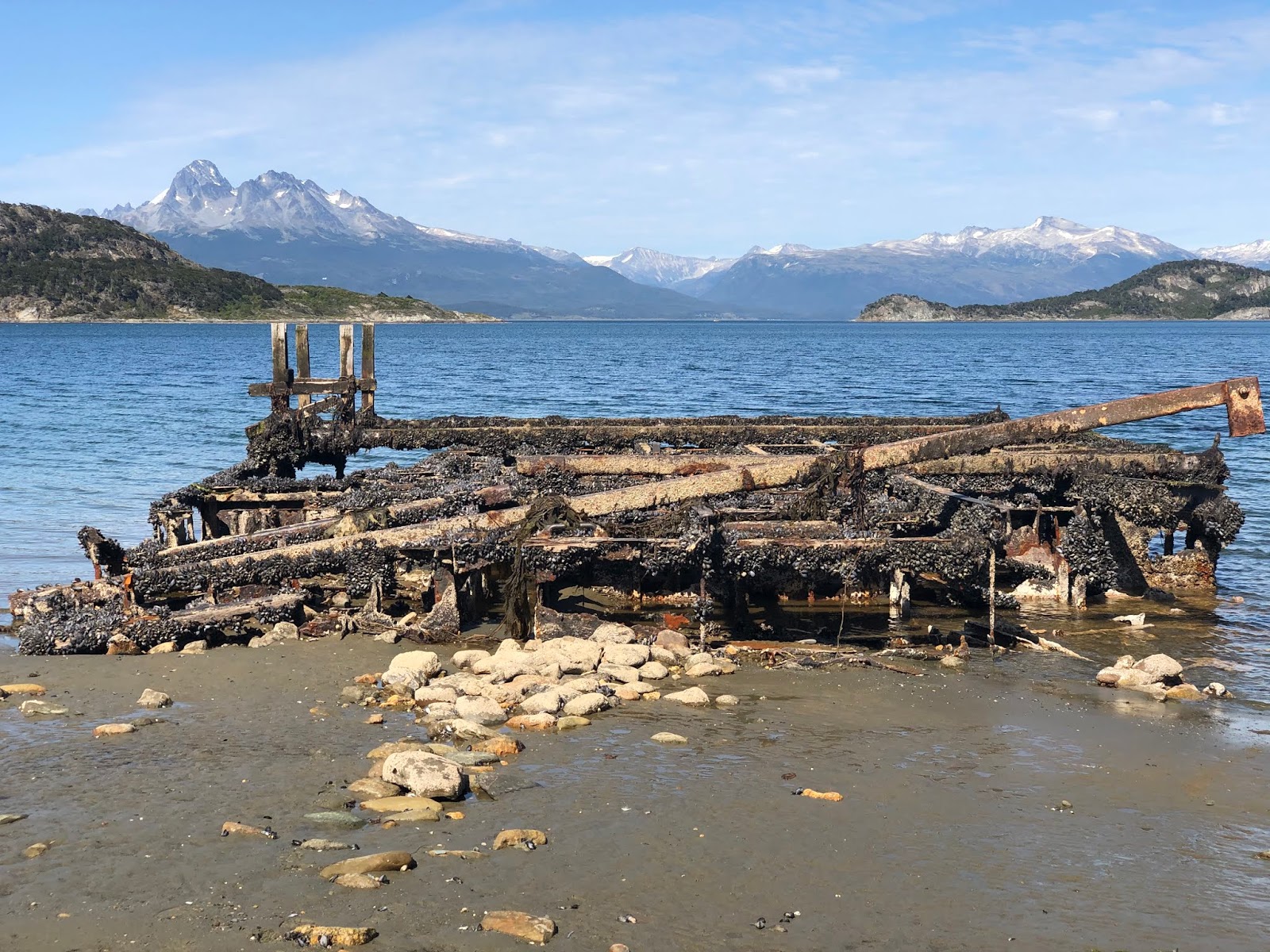
We then took off toward the Tierra del Fuego National Park. We stopped at the Bay Ensenada Zaratiegui , also called simply Ensenada Bay. It is a bay on the northern margin of the Beagle Channel which connects the Atlantic and Pacific Oceans. It has been confirmed as a sovereign part of the Argentine Republic after a long border dispute with the Republic of Chile concerning the trace of the Beagle Channel. The island in the foreground of the picture below is Isla Redonda (Argentinian) while the land mass beyond is Chile. Taking the channel to the left takes you to the Atlantic, to the right is the Pacific.


The shore is covered with mussels. The tide is out, but these guys are alive and tethered to the rocks of the shore.


An old pier now serving as a mussel sanctuary.

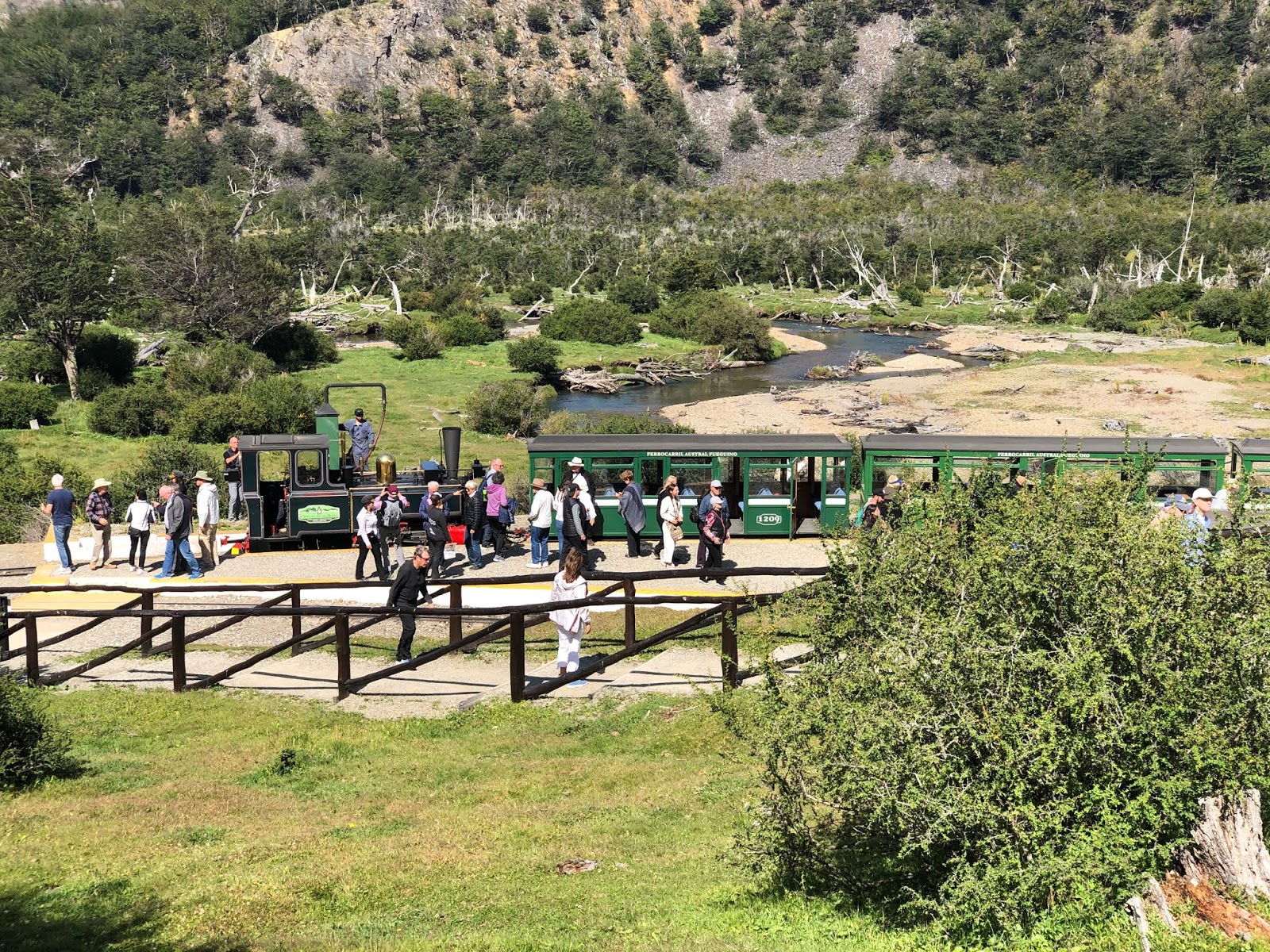
We reboarded the van and proceeded to the park where we boarded the train (https://www.trendelfindelmundo.com.ar/es). The Southern Fuegian Railway (Ferrocarril Austral Fueguino) or the Train of the End of the World (El Tren del Fin del Mundo) is a 500 mm (19 3⁄4 in) gauge steam railway. It was originally built by prisoners as a freight line to transport timber to the prison and the city of Ushuaia. It now operates as a heritage railway into the Tierra del Fuego National Park and is considered the southernmost functioning railway in the world.

The locomotive pulling our train of cars was a steam engine powered by diesel fuel. The speed was probably 5 mph at most. The trip was over 7 km (the original train covered a distance of 14 km) and after about 30 minutes of moving, we stopped briefly for some photos. The remainder of the trip, back to the starting point took another 15 minutes or so.

Along the way, the tree stumps left by the convicts were still visible. They cut trees every day all year round and would cut them off at the "ground". During days with snow on the ground, they would cut the trees off at the level of the snow. Today, there was no snow, so the height of the remaining trunks varied widely.


It was a short drive back to the ship.


We had talked about having lunch in Ushuaia when we got back to the ship. However, the Princess cruise ship, with about 2,000 guests disembarking, made us decide to eat lunch on board before walking into town.

We were hoping to find a shoe store (I need some new tennis shoes) and a pair of workout gloves for Maria. But, this was Sunday, so most of the stores were closed. We did stop at the same rock shop I visited back in December. Maria got a tiny carved penguin and a small carved giraffe.

We had a tasty ice cream before heading back to the ship. We both visited the gym in the evening.

Saturday, February 8, 2020

Day 13/35: Saturday, February 8, 2020: En Route to Ushuaia, Argentina

We are sailing the Drake Passage toward Ushuaia over night. The water was relatively chopping and there was quite a bit of "movement" overnight. It is a bit smoother this morning, but there is still some large dips and rows. The original plan was to dock in Ushuaia tomorrow around noon and depart at 6:30 pm. Now it appears we will dock this evening, between 10:00 and 10:30 pm and depart at 7:00 pm Sunday evening. Tomorrow, we have an excursion "Ushuaia, The Prison & The End of the World". Originally scheduled for 1:45 pm, today I learned it has been moved up to 9:00 am. This is due to the fact that another cruise ship will be arriving in port tomorrow morning. This ship carries about 2,000 guests and they wanted to avoid any "traffic jams" with that ship.

Ushuaia is a resort town in Argentina. It's located on the Tierra del Fuego archipelago, the southernmost tip of South America, nicknamed the “End of the World.” The windswept town, perched on a steep hill, is surrounded by the Martial Mountains and the Beagle Channel. It's the gateway to Antarctica cruises and tours to nearby Isla Yécapasela, known as “Penguin Island” for its penguin colonies.

We visited Ushuaia last December on our Viking cruise from Buenos Aires to Valparaiso. This is where I found the carved Inca Rose lion I gave to a dear friend. We'll see what we find this time.


This afternoon, we attended a tour of the Bridge. The Captain gave us his undivided attention for 45 minutes. This is a relatively old ship, approaching 20 years, and it doesn't have all the fancy high tech displays and consoles as some I have seen. One notable difference from other bridge tours I have taken is the total absence of seats for the crew to use. They stood their entire watch. They also had a "dead man" button which they were required to push at least every 12 minutes. Otherwise, an alarm would go off indicating the bridge was unmanned for some reason, dead crew...or more likely asleep crew.


Shortly after Maria came on board, she remarked how delightful she found the quality of the water and wondered why. We inquired and today, someone came to discuss the water used on board ship. The ship has a potable water tank which holds up to 1,000 tons of water. The consumption of water varies between 200 and 400 tons per day, depending primarily on whether we are at sea or in port. The ship can bring water on board from the shore or it can produce its own fresh water from sea water using a reverse osmosis system. The RO system has a capacity of roughly 400 tons per day. Depending on where they are in the world, often they prefer to not bring water from the shore so that they can control the quality of that water. The RO water is very soft and is adjusted for pH (7.0-7.4) and has chlorine added (0.2 and 5.0 ppm). If they do bring water on board from shore, it is tested by the Nurse before bringing it on board. The use of mostly RO water seems odd to me because it would be extremely soft. I have not noticed the normal tell-tale feel of very soft water however. They may do more than just control the pH and add chlorine.

It was along about 3:30 pm that we sighted land, Tierra del Fuego (Land of Fire).


Friday, February 7, 2020

Day 12/34: Friday, February 7, 2020: Half Moon Island, South Shetlands

Half Moon Island is a minor Antarctic island, lying 1.35 km north of Burgas Peninsula, Livingston Island in the South Shetland Islands of the Antarctic Peninsula region. Its surface area is 171 hectares. The Argentine Cámara Base is located on the island. Our Group 8 departed the ship at 11:00 am and we were allowed one hour ashore, which was more than enough.

This island plays hosts to thousands of Chinstrap penguins, also known as "Bobby" penguins.


Some of the zodiacs were engaged in keeping ice bergs away from the ship.


An old whaling boat on the beach, now a historical relic 

There were some fur seals on the beach as well.


We both walked up to the top of the island were the main rookeries were.


There were probably a dozen fur seals on the beach on the opposite side of the island.


Also some nesting Albatrosses at the top.


We were back aboard ship around noon and the ship set off around 12:30 pm. Our Antarctic experience has come to an end. Tomorrow is a sea day and then we dock in Ushuaia, Argentina.

Day 19/41: Friday, February 14, 2020: At Sea, Last Day of Segment 2

Our final day at sea on Segment 2. It is therefore going to be leisurely day. I attended a couple of final lectures by the members of the E...